2026: Year 11 & 12 Category: Speculative Fiction Award
Copper Dawn
by Lucy Pietsch, Dickson College
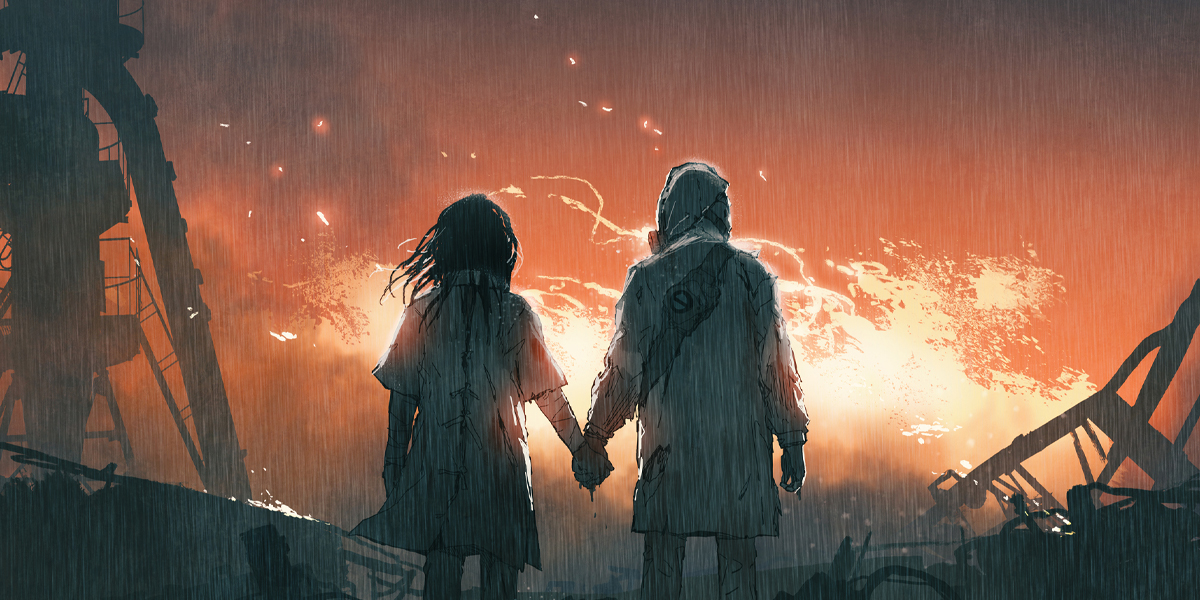
I play pretend inside the corpse of a house. The wallpaper is all blistered and peeling, heavy with the sickly-sweet smell of small things dying out of sight. Downstairs, the Wasteland King watches over his flock, teenaged ghosts with rattling coughs who gather whatever will burn into what used to be a kitchen. I hear them as I lie across a child’s bed, running my hands through Ivy’s hair while she tunes her guitar. Posters on the wall, a stuffed toy duck hidden beneath a rotting blanket. In my mind this is my room, and Ivy’s staying over and the sheets don’t smell half so bad. We’re eating food that we didn’t kill nor came from a can; it's cold outside so the heater’s on, and we’re whispering because it's a school night and otherwise Mum would kill me. I imagine my hair clean and my arms unscarred. Ivy I don’t change at all. She winces as she takes a long swig from the bottle before twisting her neck to watch me.
“An airship’s passing tomorrow,” she says. “You’ve got until then to decide.” In an instant the fiction is broken. A cold wind blows in from the hole in the roof where, an age before, a shell struck.
I sit atop the roof, watching the green dawn. The world outside is a barren ocean floor, rivers of plastic detritus clogging Earth’s pores, dead grass stuck in matted clumps. Abandoned houses stud the ridges like rotting teeth. Atop the nearest hill, new steel shines; a structure like a radio tower, an airship docking point, built back in the days when these hills teemed with people like Ivy, enamoured with tales of craters wreathed in green, of cavern cities in the South, of fish swimming in the rum-dark sea. I watch swallows dance on the sandpaper wind.
“I know about Ivy,” the Wasteland King says.
I jump up, cursing his near-silent gait. “I can handle it,” I say. “She’s just confused.”
The King draws closer. He’s mine and Ivy’s age, what would have once been young adulthood. His nose is crooked from breaking it only weeks before we first met. “I’m sorry, June,” he says, with real pain in his voice, “but I can’t stand by anymore. Too much is at stake. All that we have built.”
“Ivy’s the only one who wants to go. The rest know their duty.”
The Wasteland King gestures me to the edge of the roof. “Look,” he says. Down below the ghosts sit and listen as Ivy plays, a light floating tune like birdsong. Some are as old as Ivy and me, but many are younger, gawky preteens with sunken eyes. “Can you imagine what it must be like,” the King asks, “to have only a toddler’s memory of the time before? Where you and I have oceans, I ask them to drown in puddles. Their faith is fickle. If Ivy leaves, more will follow.”
I reflexively start to back away from him, back towards the roof’s edge. “Please,” I say, “don’t hurt her.”
The Wasteland King stalks after me. “I want you to relay a message to Ivy. If she leaves, I will kill you.”
“What?” I stumble back in horror. Behind me is only air now.
“She refuses to accept her reality. That optimistic morality will keep her here. With you.”
“And if you’re wrong?” The tiles shift beneath my feet.
“Mourning always comes with pain, June,” he bows his head. “I would not have told you any of this if I didn’t trust you to make the right decision. Can I trust you?”
Suddenly the roof beneath him gives way. For a second that seemed to take years to unfold, the Wasteland King tumbles, arms flailing, eyes wide in shock. Then my arm is outstretched, hand gripping his wrist, his descent averted before it can even begin.
“Yes,” I say. The Wasteland King grins.
“I want to perform live. At a concert.” We’re in the bedroom again, me on the bed, her sitting on the floor.
“Nobody holds concerts anymore,” I say.
“They say in the South people still do. That down there people celebrate. Concerts, parties,” she pauses, “weddings.”
I’m accosted by the image of a wedding officiated by the Wasteland King, of myself in a white dress surrounded by rubble, chemical fire biting at the veil. It makes me ill. “It sounds impossible.”
“I know.” Ivy’s eyes are sparkling.
The Wasteland King is right. I can’t convince her to stay. Not alone. I hope one day she can forgive me. I relay the King’s ultimatum. Her eyes widen in horror. For a second I think the plan has worked, before her jaw sets in defiance.
“Nothing’s changed. We leave at the last possible moment. Catch the Southbound airship.”
Panic grips me. “You’re not listening Ivy? He’ll hurt me.”
“Not if you leave! This guy just gave you every reason to run.”
“I made an oath,” I say. “Mourn eternal, ye who…”
“You were 12! It's insane, June. Why can’t you see that you could be happy?” Now she’s yelling, tears rolling down her cheek.
I stand up and look her right in the eye. “None of us deserve that.” It's the last thing I say to Ivy before two older boys rush in and grab her. She looks at them with something like betrayal. Even in my anger, my stomach drops as they force her down the basement stairs. The Wasteland King lays a bony hand on my shoulder.
In the bedroom alone, I try to pretend. The room remains empty. The roof remains stubbornly unmended. The only images I can bring forth are nightmares. Sirens. Tarmac dripping in the gutter. Camouflage jackals on the road. Rising from the rubble, to see all the good things ripped away. A hand offered by a boy with a broken nose. A desperate oath, from a girl who had not quite yet realised she still lived. Mourn eternal, ye who toils beneath the copper dawn. Creature who remains, know no relief but the pennant's waking dream. A promise easily kept, but for the girl with a guitar.
Overhead I can hear the growl of an airship. In another hour it would pass by undisturbed. We’d move on at first light, at home again in the endless waste. No tearful goodbyes, no cities in the South, no more lonely nights. But I’ve spent enough time in fantasy. There is still somebody who deserves a happy ending in the Wastes. It's time to set her free.
I gather our things, my bag slung over one shoulder, Ivy’s guitar over the other, and take one last look at the bedroom, giving a silent apology to whoever once lived here. Through the hole in the ceiling I can see it: a great bird, wings spread wide out over the wastes. An airship. As I make my way through the house, it looks different. Barely recognisable as a dwelling. No longer a corpse. All that's here now is absence; empty bedrooms and lives unlived, but it hurts like nothing has since everything ended.
In the downstairs, scared teenagers huddle together, sleeping under dirty blankets. I descend the basement stairs and pull away the cabinet that's been jammed in front of the door, wincing at its sounds of protest. The door creaks open. Moonlight spills into the darkness, illuminating the thin layer of water at the bottom. For a second I think it's empty, until a small form emerges from hiding beside the door frame. Ivy grabs the front of my shirt, eyes wild and fist raised. She only lowers it when she sees that it's me.
“I’m sorry,” I say, arms shaking. She nods and gestures for me to follow her out.
At the top of the stairs, the boy I once called the Wasteland King stands, silhouetted in the dark. In his hand something glints in the light. Between us and the door. “How dare you,” he yells, and I watch in horror as slowly the teenagers around him wake up and stand. The boy grins in triumph, knowing he has won. Then the teenagers charge. A dozen bodies slam into the boys, thin pale arms clawing for the knife. Amidst the chaos, somebody calls for us to run, and the two of us race outside, the wind in our hair, and we remember how to live.
JUDGES’ COMMENTS
Ivy, who is the protagonist, the Wasteland King and the narrator inhabit a dystopian future world. This oppressive world is created through strong descriptive language such as ‘a barren ocean floor, rivers of plastic detritus clogging Earth’s pores, dead grass stuck in matted clumps’, and effective imagery in similes such as ‘Abandoned Houses stud the ridges like rotting teeth’. The writer also creates suspense as an escape is plotted into an unknown but hopefully better world. The judges felt this piece had echoes of current global conflicts whilst maintaining a flair and originality all of its own. The conclusion is powerful and implies violence; yet we are delighted that Ivy and the narrator can escape and ‘remember how to live’.